Linear Attention
In the age of AI, everything below is handcrafted!!!
If you follow open-source models, you may have noticed that several recent foundation models use linear attention, such as Kimi K3, Kimi K3.1 Pro, and Qwen3.8-Flash-Next.
I will use a series of concise, hand-drawn explanations to explore representative work on linear attention.
Each post distills one original paper, and the posts build on one another logically. By the end, you should have a solid understanding of today’s most important linear-attention mechanisms—Kimi Delta Attention (KDA) and Gated DeltaNet—and be better prepared to follow how model architectures are evolving.
Feedback is welcome at flying_xf@icloud.com.
Blog 1: Naive Linear Attention
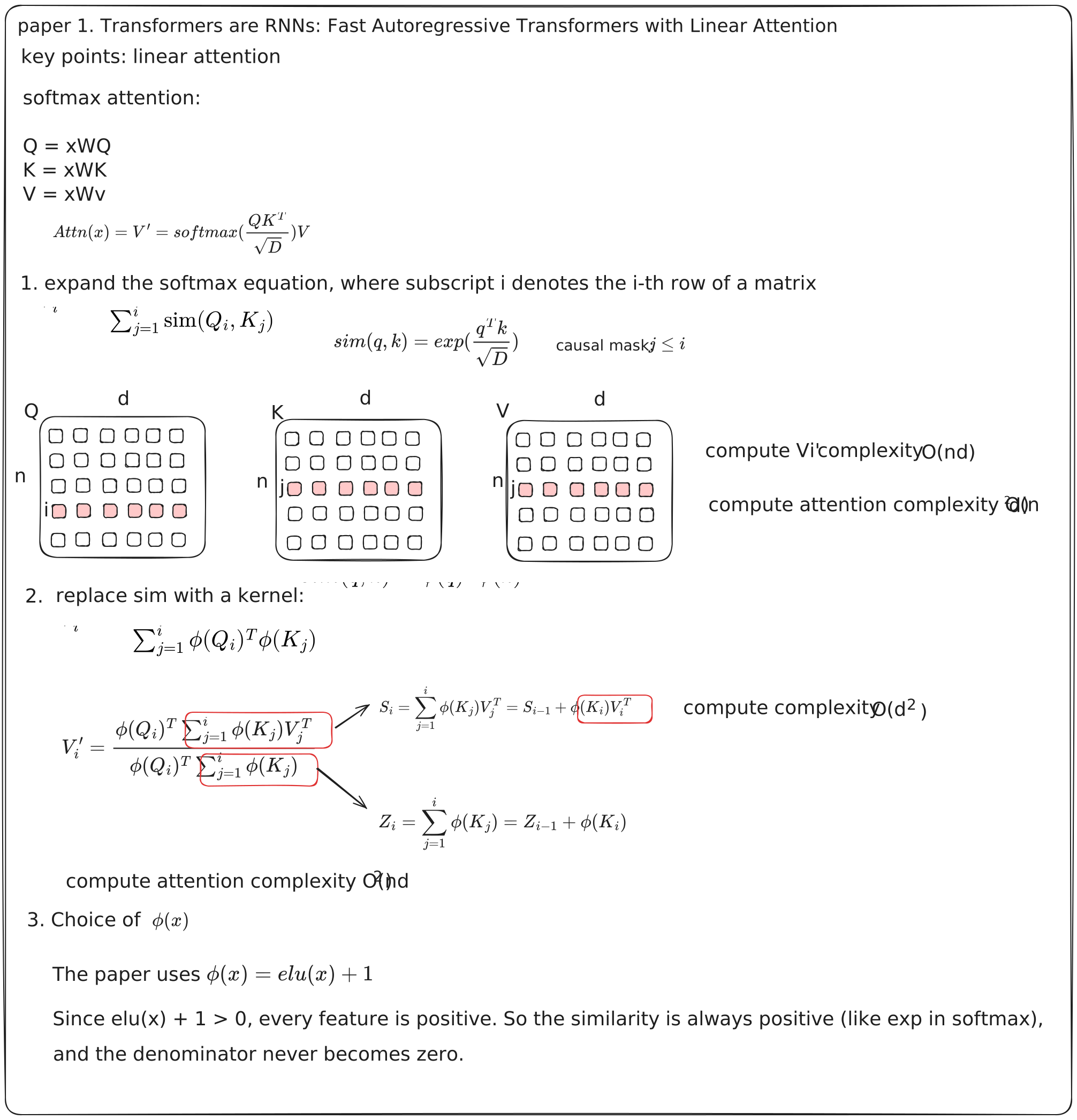
I want to start from the very beginning: the paper “Transformers are RNNs: Fast Autoregressive Transformers with Linear Attention”.
The main contribution of this paper is a new kernel function that replaces the original softmax function. This decouples q and k and yields a computation method with O(nd²) complexity, where n is the sequence length and d is the hidden dimension.
Blog 2: Delta Rule
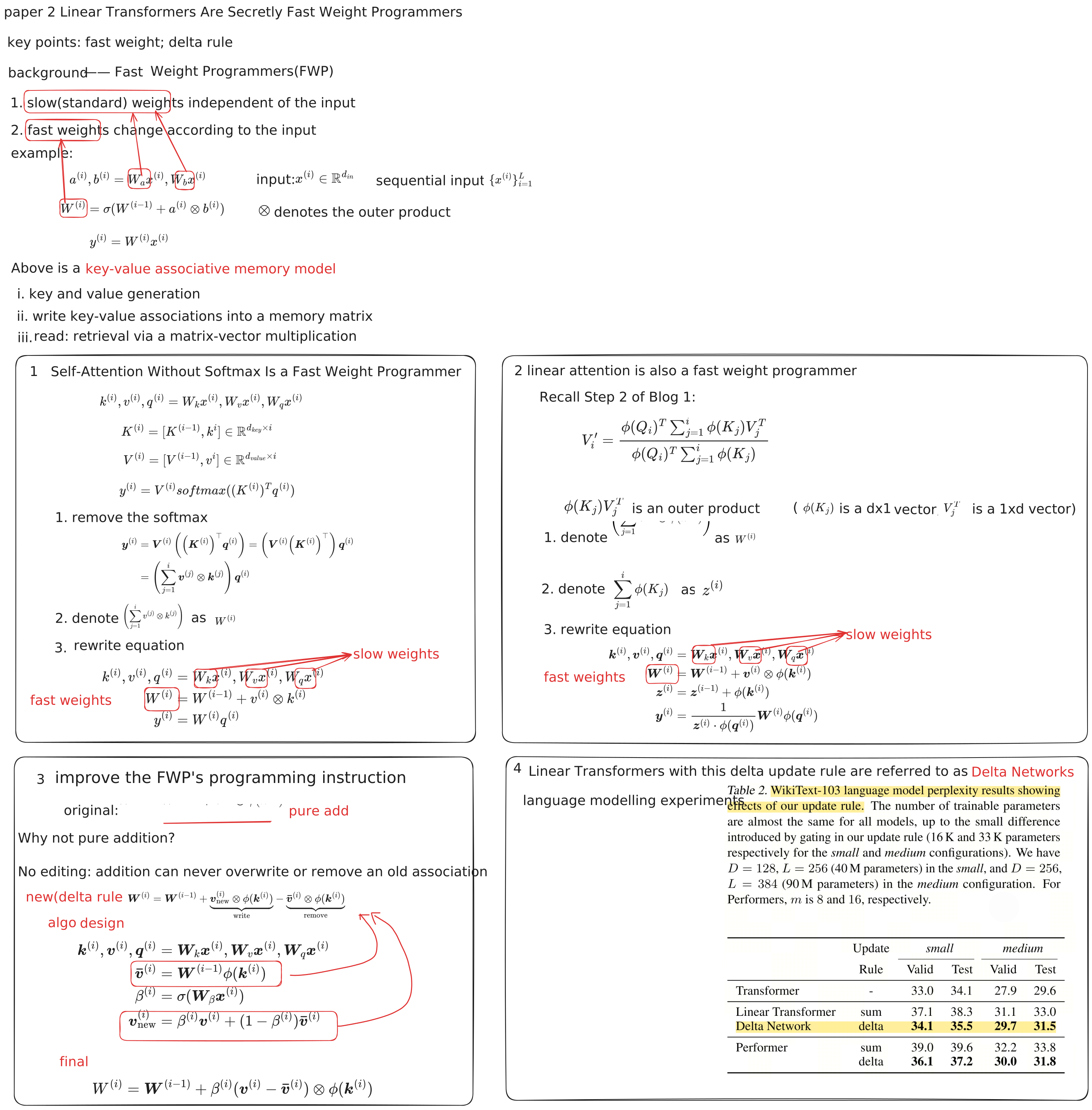
The second post is about “Linear Transformers Are Secretly Fast Weight Programmers”. Drawing on the delta rule proposed in early AI papers, it interprets linear attention as a key-value associative memory model and proposes Delta Networks.
Blog 3: Gate Rule
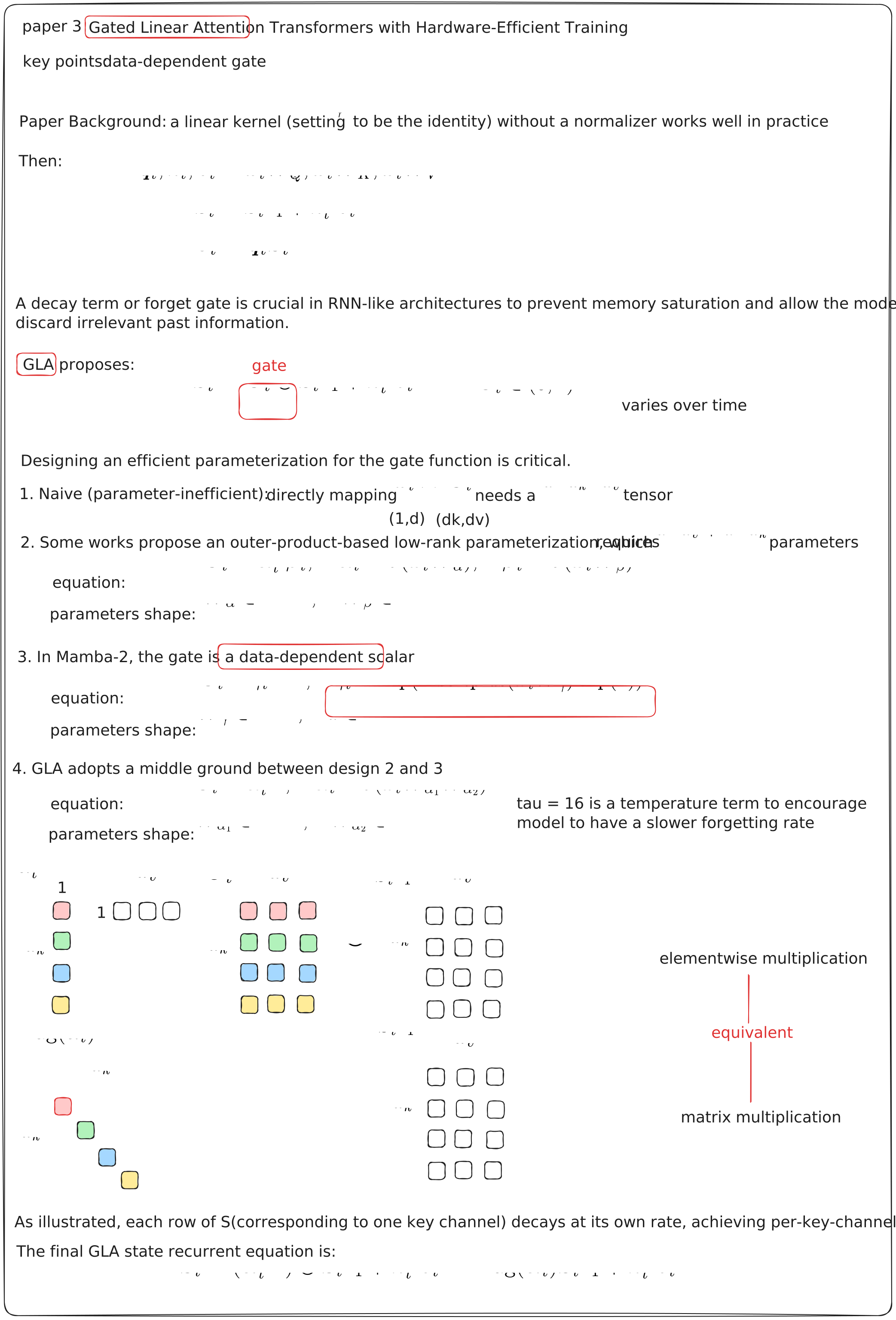
The third post is about “Gated Linear Attention Transformers with Hardware-Efficient Training”. Its central idea is a data-dependent gate that lets the recurrent state forget information over time.
The key design problem is how to parameterize this gate. A naive formulation can be parameter-inefficient; low-rank and scalar alternatives make different trade-offs; and GLA chooses a middle ground that supports efficient training. In the final recurrent equation, each key channel forgets at its own rate, giving the model per-channel forgetting.
Beyond the gating formulation itself, the paper also tackles a systems question: how to reorganize linear-attention computation for greater parallelism. This series focuses on algorithms; I may cover operator-level implementations in a separate systems-oriented series.
Blog 4: Gated DeltaNet & Kimi Linear
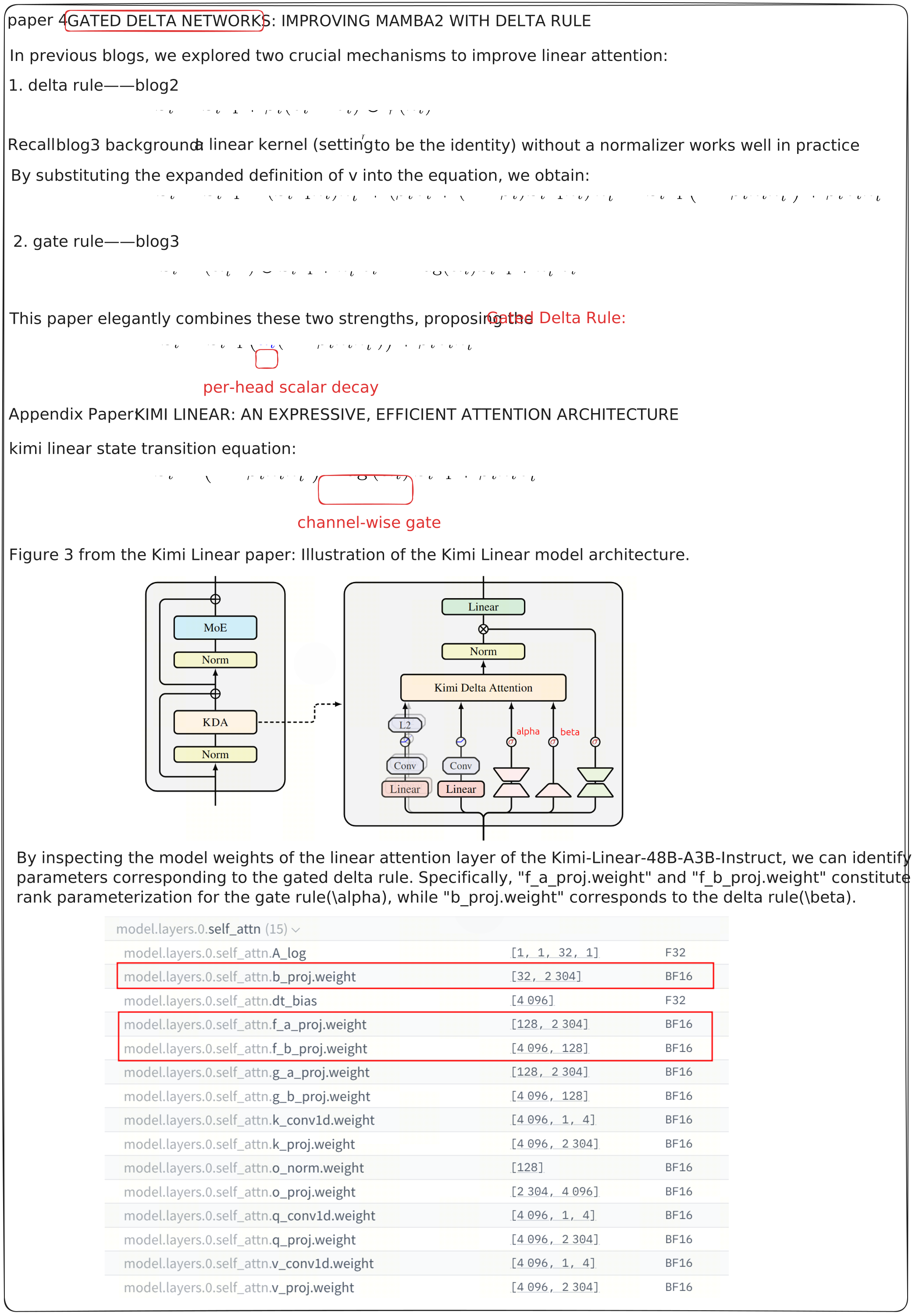
The fourth post is about “Gated Delta Networks: Improving Mamba2 with Delta Rule”. It combines two ideas from the previous posts: the delta rule from Blog 2 and the gate rule from Blog 3.
The result is a gated delta rule that preserves the correction behavior of the delta rule while adding a data-dependent forgetting mechanism. This direction leads naturally to later architectures such as “Kimi Linear: An Expressive, Efficient Attention Architecture”, which combines channel-wise gating with per-head scalar decay.